Thyroid Biopsy: Addressing Common Concerns

Discussions about biopsy often stem from misinformation. To clarify, we will address some frequently asked questions regarding fine-needle aspiration (FNA) biopsy of the thyroid gland.
Is a thyroid biopsy painful?
The sensation during an FNA biopsy is comparable to that of an intramuscular injection—the only difference is the location. It is called a fine-needle aspiration biopsy for a reason. The procedure uses 23-25G needles, which are even thinner than those used for intramuscular injections. Therefore, concerns about pain are largely unfounded. In the hands of an experienced physician, the procedure should not be painful.
Can the needle be misplaced during the procedure?
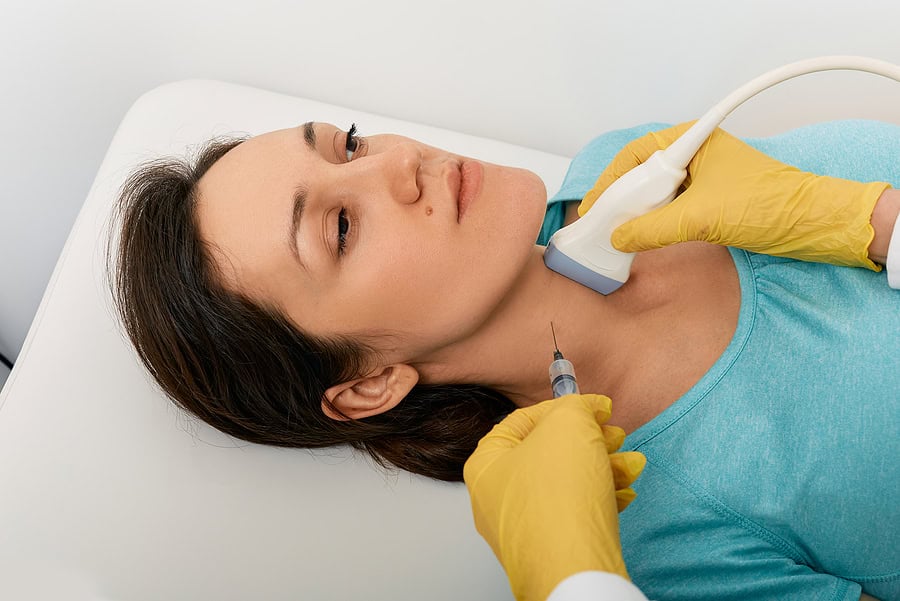
To ensure precise needle placement within the nodule, the biopsy is performed under ultrasound guidance. This eliminates the risk of incorrect placement, as the doctor can visually track the needle's position in real time.
Does an FNA biopsy increase the risk of cancer spreading beyond the thyroid gland?
No, this is a common misconception. Numerous studies analyzing nodules surgically removed after FNA biopsy have shown no evidence of tumor spread beyond the thyroid gland.
“If you don’t touch it, there won’t be any problems” – Will the nodule start growing faster after a biopsy?
Fine-needle aspiration biopsy does not cause nodules to grow more rapidly. If a nodule had a tendency to grow before the biopsy, it will continue to do so afterward. If not, the biopsy will not trigger its growth.
How should I prepare for a thyroid biopsy?
No special preparation is required. The only recommendation is to avoid coming on an empty stomach. Unlike a blood test, this procedure is not affected by food intake. However, fasting may lead to dizziness or weakness during the procedure, so it’s best to eat beforehand.
How often should a biopsy be repeated?
FNA biopsy is a diagnostic method, not a long-term monitoring tool. If the biopsy provides a conclusive result, there is no need for repetition. A repeat biopsy is only necessary if: A benign nodule was initially detected but later showed significant growth. New concerning symptoms appear, such as hoarseness, persistent cough, difficulty breathing, or swallowing issues.
Should I agree to a thyroid biopsy without ultrasound guidance?
Absolutely not. A "blind biopsy," performed solely by palpation, is an outdated technique. Biopsies conducted with and without ultrasound guidance are fundamentally different procedures. The accuracy of ultrasound-guided FNA biopsy is significantly higher than that of a "blind" biopsy. My biopsy results were inconclusive.
Should I repeat the procedure?
Yes, definitely. Both you and your doctor need a clear, definitive answer from the biopsy. If the initial sample is insufficient, the biopsy should be repeated. It is important to note that an inconclusive biopsy result does not indicate a lack of expertise from your doctor. In some cases, a second biopsy is simply necessary to obtain a more informative sample.
What if the second biopsy is also inconclusive?
In such cases, a more thorough evaluation is required. Some nodules are inherently difficult to assess, even with repeated biopsies. If you trust the medical institution conducting the biopsy, consider undergoing the procedure one more time.
Experience shows that non-informative nodules are often benign, so there is no need to rush into surgery.